
Mega funding ($100 Mn and above) trends in 2025 unravelled a tale of contradictions. While Indian startups witnessed a dramatic contraction in mega deal activity, the average capital deployed per startup rose.
As per Inc42’s ‘Annual Indian Startup Trends Report, 2025’, only 18 mega rounds (exceeding $100 Mn) materialised this year, down 25% compared to 24 such rounds last year.
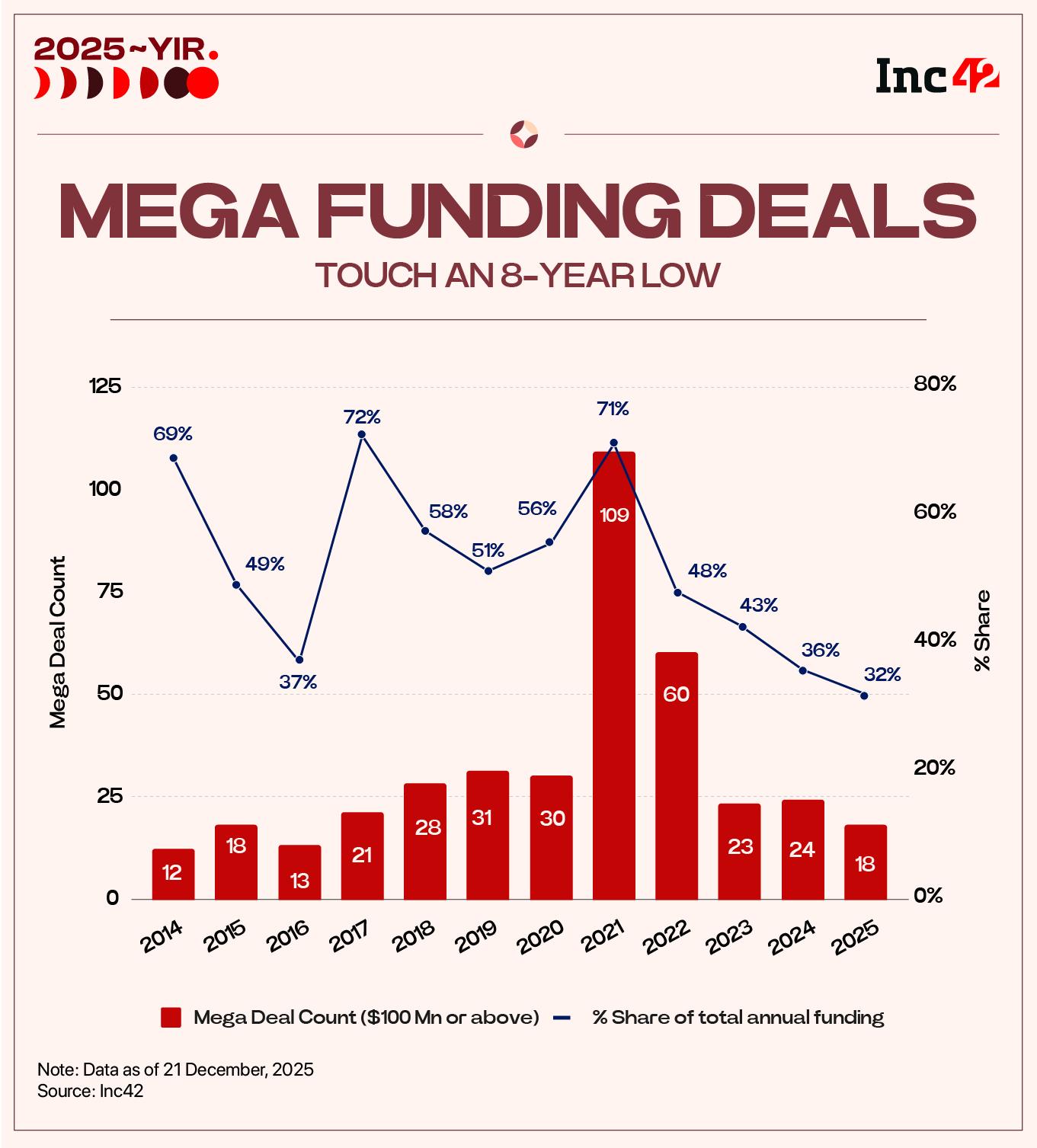
These mega deals raked in 32% ($3.5 Bn) of the total funding ($11 Bn) raised by Indian startups in 2025. In contrast, late stage giants lapped up $4.6 Bn from mega deals in 2024.
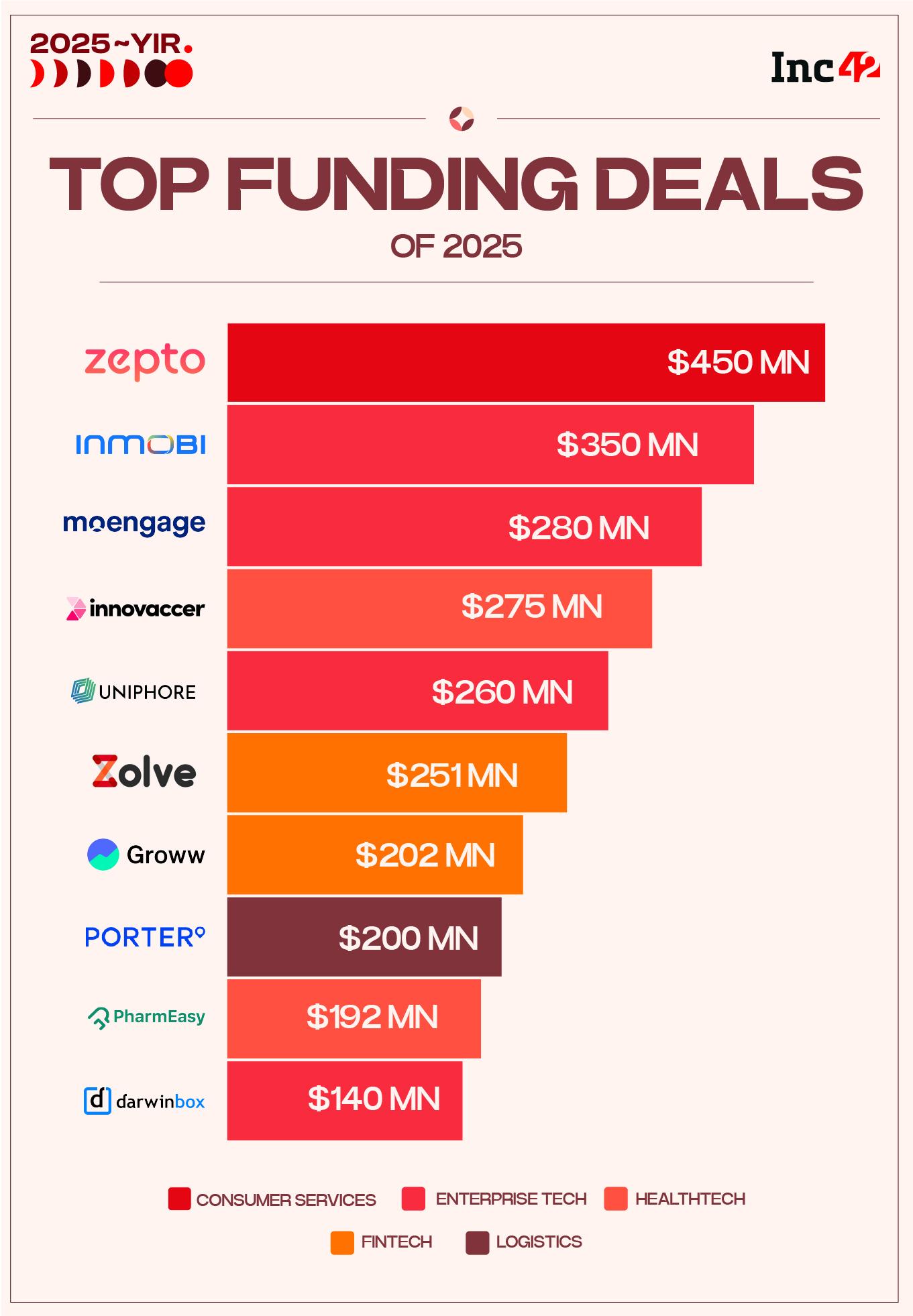
Notably, IPO-bound quick commerce major Zepto continued to top the charts this year too, bagging $450 Mn in a single sweep in October. Adtech giant InMobi ($350 Mn), martech platform MoEngage ($280 Mn), conversation automation giant Uniphore ($260 Mn), and healthtech platform Innovaccer ($275 Mn, including debt) were some of the biggest mega deals of 2025.
The year also witnessed a stagnation in deal value. Funds totalling over $12.1 Bn were launched in 2025, yet a mere $3.5 Bn went towards mega deals. This signals that venture capital (VC) and private equity firms are taking a cautious approach towards big-ticket ventures.
Mega deal fundraising, as a percentage of total funding, also slipped below 30% for the second time since 2017.
So, what exactly does this 2025 mega deal contradiction mean?
Fewer Winners, Bigger Bets
The year’s less-than-impressive tally of mega rounds was a fundamental recalibration of investor behaviour and startup readiness.
The pattern was clear. The capital flowed almost exclusively to category leaders with defensible moats, proven unit economics and near-term profitability or IPO readiness. The era of writing large cheques to unproven concepts or cash-burning experiments appears largely over.
The usual suspects, SaaS and quick commerce, dominated mega round activity, reflecting investor preference for platforms with recurring revenue, big addressable market and credible exits.
What also made the YoY decline in deal count particularly striking was the concentrated nature of capital deployment, suggesting that while fewer companies are accessing mega rounds, those that do are securing substantially larger tickets.
This structural shift in mega deal activity – higher amount per ticket size – reflects a broader maturation of India’s VC ecosystem. Late stage investors are overlooking burn rates in favour of GMV growth or betting on winner-takes-all market dynamics.
This reset could have a cascading effect. Startups seeking mega-rounds now arrive with audited financials, profitability metrics and detailed IPO preparation timelines. Governance, compliance and sustainability have become non-negotiables, not nice-to-haves.
But beyond the investor recalibration, the absence of big VC hitters impacted mega deals this year.
Access Free ReportSoftBank And Tiger Global Pullback
Much of the mega deal slowdown could be traced to the dramatic retreat of two of the biggest investors in the Indian startup ecosystem – SoftBank and Tiger Global.
Both firms, once synonymous with India’s mega-round boom during 2020–21, pulled back sharply in 2025 after absorbing significant losses on their vintage investments from that period.
SoftBank’s portfolio from that period, especially recently listed Meesho and IPO-bound OYO, faced steep markdowns in 2025 (in the range of 20-70%), as they continued to struggle with profitability and valuation corrections. Similarly, Tiger Global has also recalibrated its India strategy and pivoted to highly selective bets.
Their pullback has left a vacuum, which is being filled partially by domestic backers. These new investors, along with sovereign wealth funds and India-focussed growth funds, are operating with greater due diligence, longer evaluation cycles and stricter profitability benchmarks compared to their predecessors.
Looking ahead, the mega deal environment is unlikely to return to 2021 levels. Instead, 2026 will likely see a continuation of selective, concentrated capital deployment into pre-IPO candidates and category leaders. Mature late stage ventures are expected to attract the bulk of mega-rounds, provided they demonstrate strong unit economics and near-term profitability.
While the capital is abundant, it is flowing only to those startups that can demonstrate execution and have a credible path to sustainable scale. As we step into 2026, the question is no longer how many mega deals will Indian startups close next year, but which ones will prove worthy of them.
[Edited by: Shishir Parasher]
The post 2025’s Mega Deal Paradox: Volume Tanks, But Ticket Size Soars appeared first on Inc42 Media.
from Inc42 Media https://ift.tt/JxzHG3X
via


0 Comments